SLAGSHOT

Devlog

How Slagshot is being built, newest entry first. Each entry has a video on YouTube when it is ready.

Devlog 4: the first playtest, and five wins that came too easily

Entry 4 · November 11, 2026

Today the first packaged build went out to an invited tester: a plain Windows download, installed and played outside the development setup for the first time. The first report came back within the hour:

“I just installed the build, and won 5 matches in a row on one shot in the campaign.”

That breaks a rule this game holds onto. Lethal physics stays in, but a one-shot win has to be earned: set up over several turns by undermining, flooding or burning, not handed out by a single standard shot.

The game is deterministic, and the campaign saves the seed of every battle, so all five matches could be replayed exactly. Here is what the run shows:

SappersWon on turn one. The shot brought stone down as a rockfall.
Sapper captain (elite)Lost. The captain hit for 102 on its first turn, more than the tester's 100 health.
Siege engineersWon on turn one, again by rockfall.
Siege, round twoWon in two turns.
Magma warden (elite)Won on turn one.

It cuts both ways: the tester won four times on the opening shot, and lost once to the enemy's. Campaign units start with 70 to 100 health. In a Quick Match they start with 160, and an ordinary full-strength shot in this build deals between 115 and 240. The campaign numbers look like they were never raised when Quick Match was. That is being checked now, along with whether the campaign's defence cards and cover work the way they do in Quick Match.

The fix is in progress. The test it has to pass is simple to state: no enemy in Acts I to III dies to one standard shot from full health, unless the player built the situation over earlier turns. Once it passes, the next tester build goes out and the next entry will say how it went.

This is what playtesting is for. Thank you to the first tester.
Devlog 3: five card tiers, ice, methane and heavy ordnance

Entry 3 · November 6, 2026

Cards now come in five tiers: basic, common, uncommon, rare and legendary. A reward picks the tier first, then the card, and each tier has its own frame so you can read a hand at a glance.

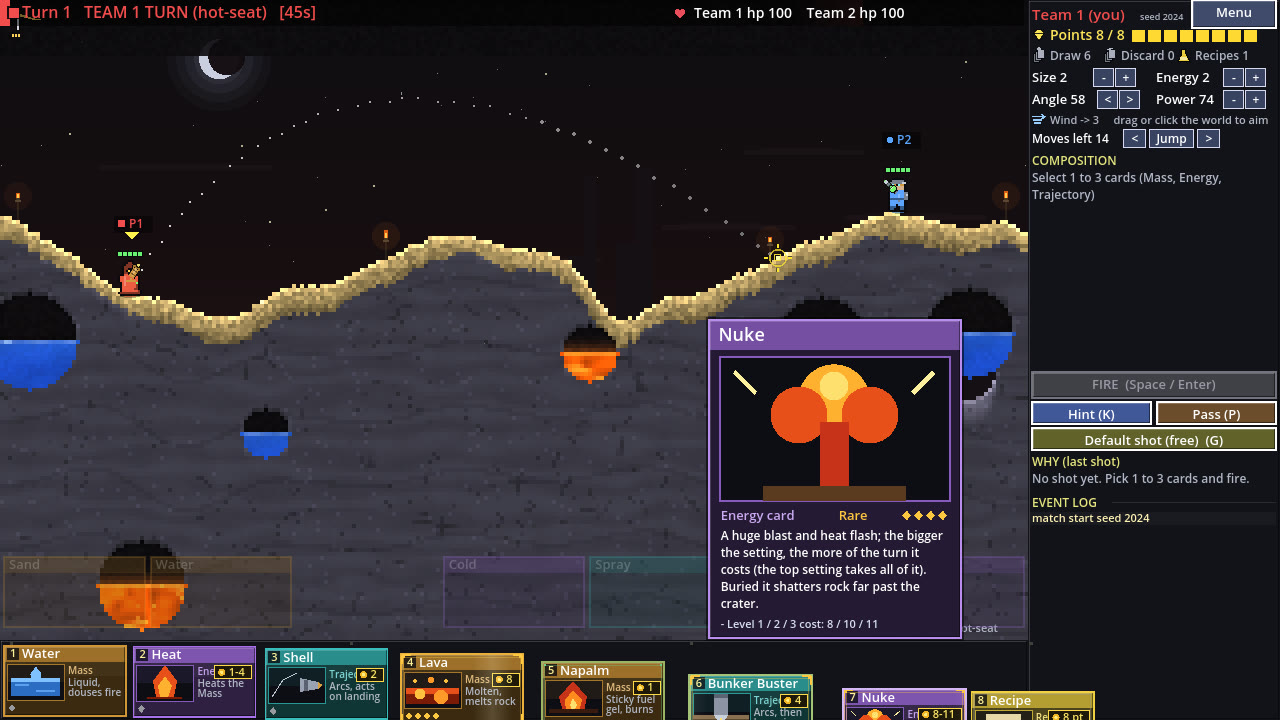
The hand at the bottom of the screen, with the Nuke card open in its rare frame.

Last entry's strongest shot, the Warhead card, is gone. The same combination of cards still works; it is now a discovery you make by building it yourself, called “The Final Argument”.

New matter for the simulation:

  • Ice. Cold freezes water and heat melts it back.
  • Methane. A gas that rises, and burns.
  • Wood burns to ember, then to ash. Burn a brace and the ledge above it drops.

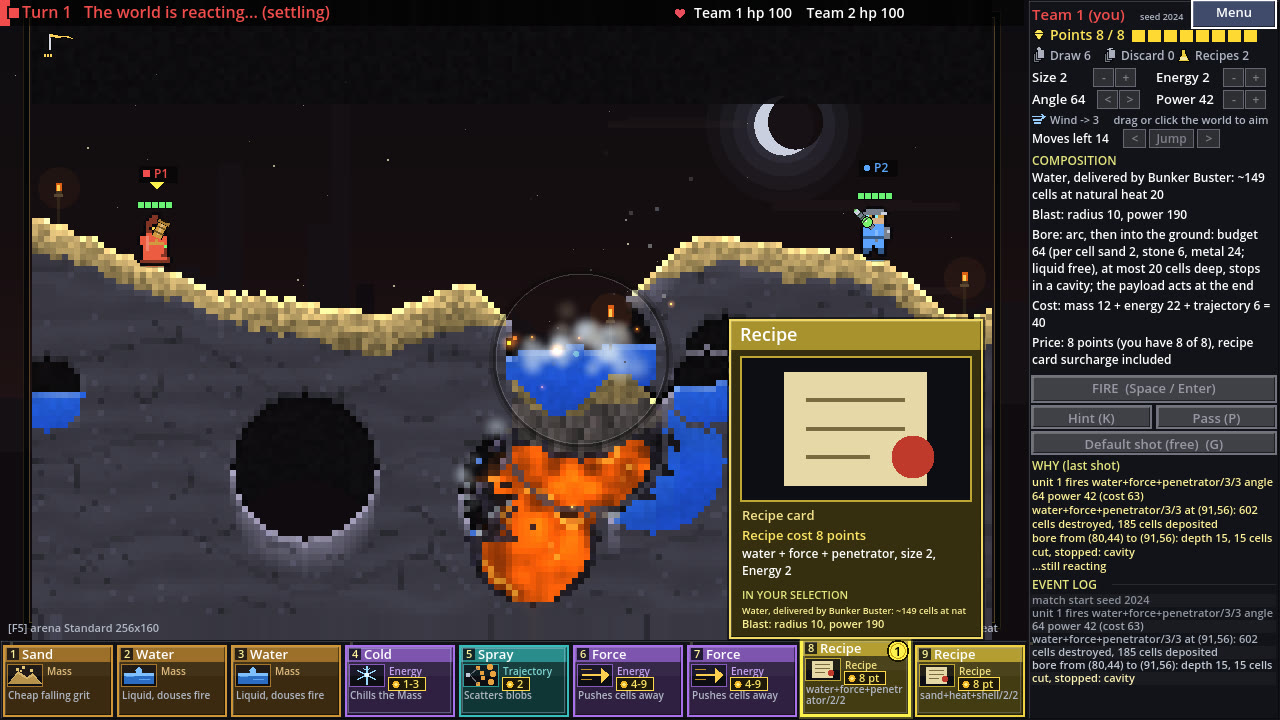
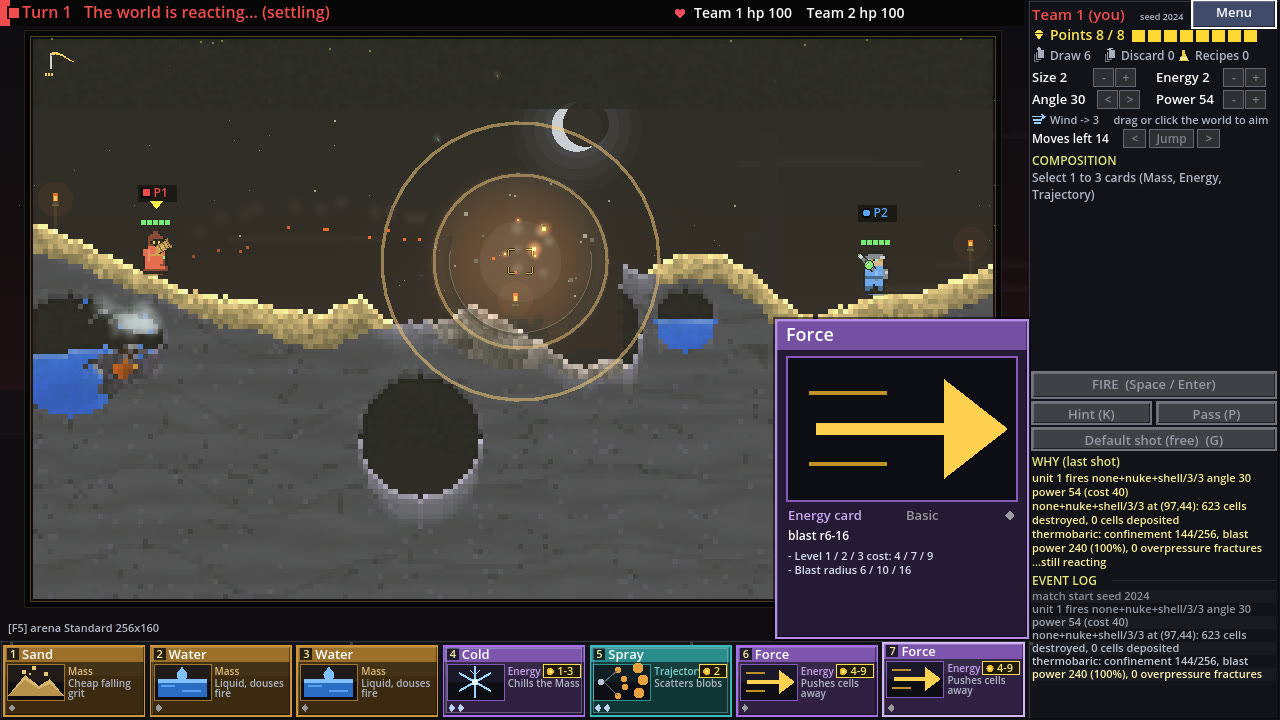
New heavy ordnance: Bunker Buster, Nuke, Drill, Concrete and Napalm. The Bunker Buster bores into rock before it goes off, so the blast happens inside the hill instead of on its surface.

A Bunker Buster round has bored into the hill; water and lava pour into the cavity it opened.

The flash and shock ring of a nuke going off over the battlefield.

Also new: Horde mode (waves of walkers against your base), a skirmish setup with a person or the AI in each seat, AI-against-AI matches to watch, a local score table, and achievements.

Still rough: methane looks murky, ice cracks look too regular, and several screens have not had their graphics pass yet.

Devlog 2: a bigger board and real cards

Entry 2 · November 5, 2026

A graphics and feel day. The rules of the simulation did not change; this entry is about how the game looks and how you get around it.

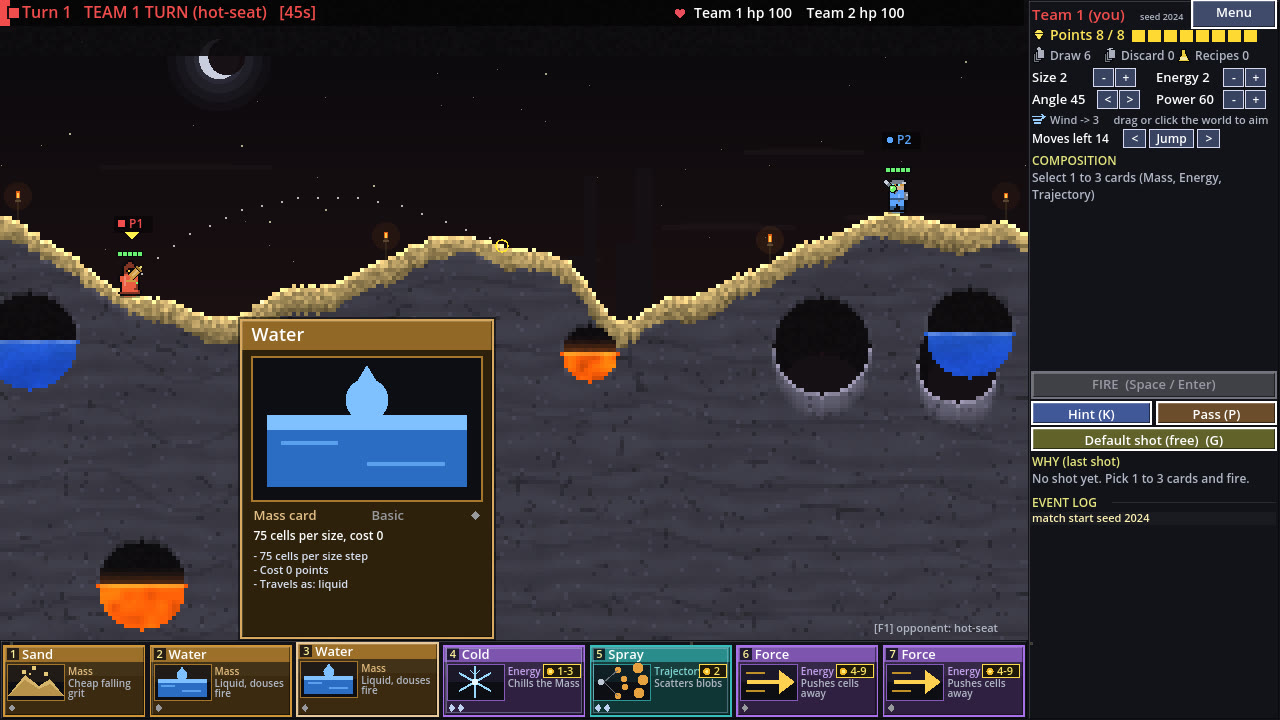
Cards have faces. Every card now has its own pixel art, a frame colour for its type and a cost chip. Hover a card and a larger version shows the full text.

The Water card enlarged over the battlefield, showing its art, type and cost.

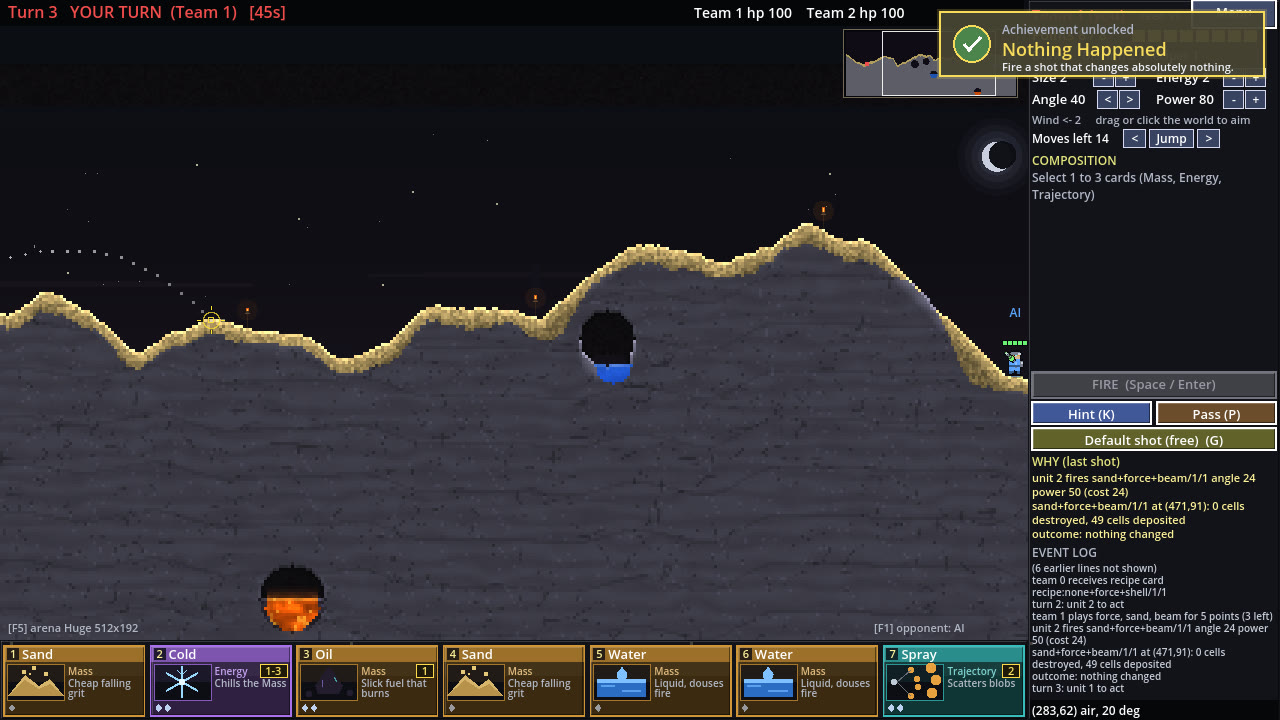
A board you can pan. Arenas can now be bigger than the screen. Drag with the mouse, use the arrow keys or push the pointer to the edge; a minimap keeps you oriented, and the camera can follow the shell to where it lands.

A wide arena with the minimap in the top-right corner showing the whole board.

More going on in the world. Stone has cracks, water ripples and lava pulses. Impacts throw debris, sparks, embers, dust and steam. A low-effects setting turns the decoration off and keeps everything you need to read a shot.

The strongest shot. I asked the game which legal play hits hardest. The answer was a Nuke fired as a shell with every point spent. I had hoped it would be a molten slag round; the simulation disagreed, and the simulation decides.

Devlog 1: the one rule

Entry 1 · November 4, 2026 · video coming soon

One rule runs this whole project:

The cards set the starting conditions. The simulation decides what happens.

Every pixel of the battlefield is simulated: sand, rock, water, lava, steam, oil, wood, gas, acid. A card never says how much damage to deal. It says what matter to make, how much energy to give it, and how it flies. After that, the simulation decides.

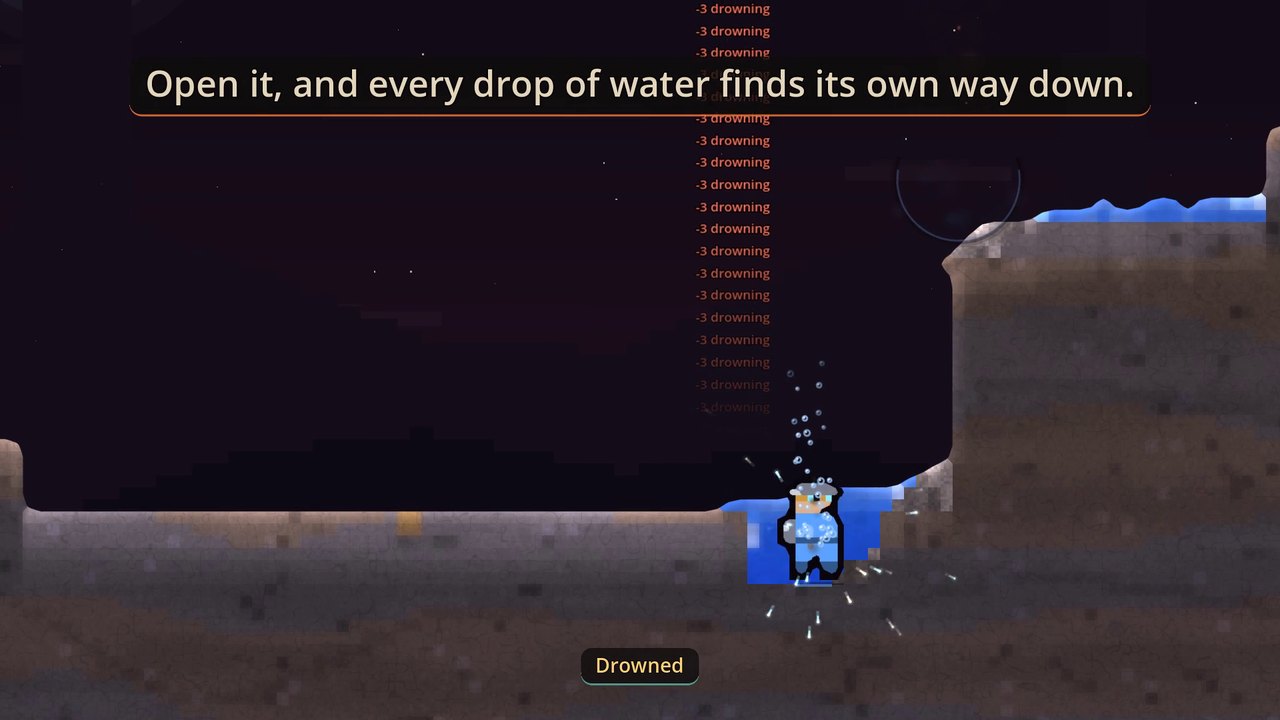
The rock wall is open and the lake pours down onto the unit below.

Open the wall, and gravity does the rest. Every drop of that water is simulated; nothing about the flood is scripted. The unit below is hurt because the water reached it, not because a card said so.

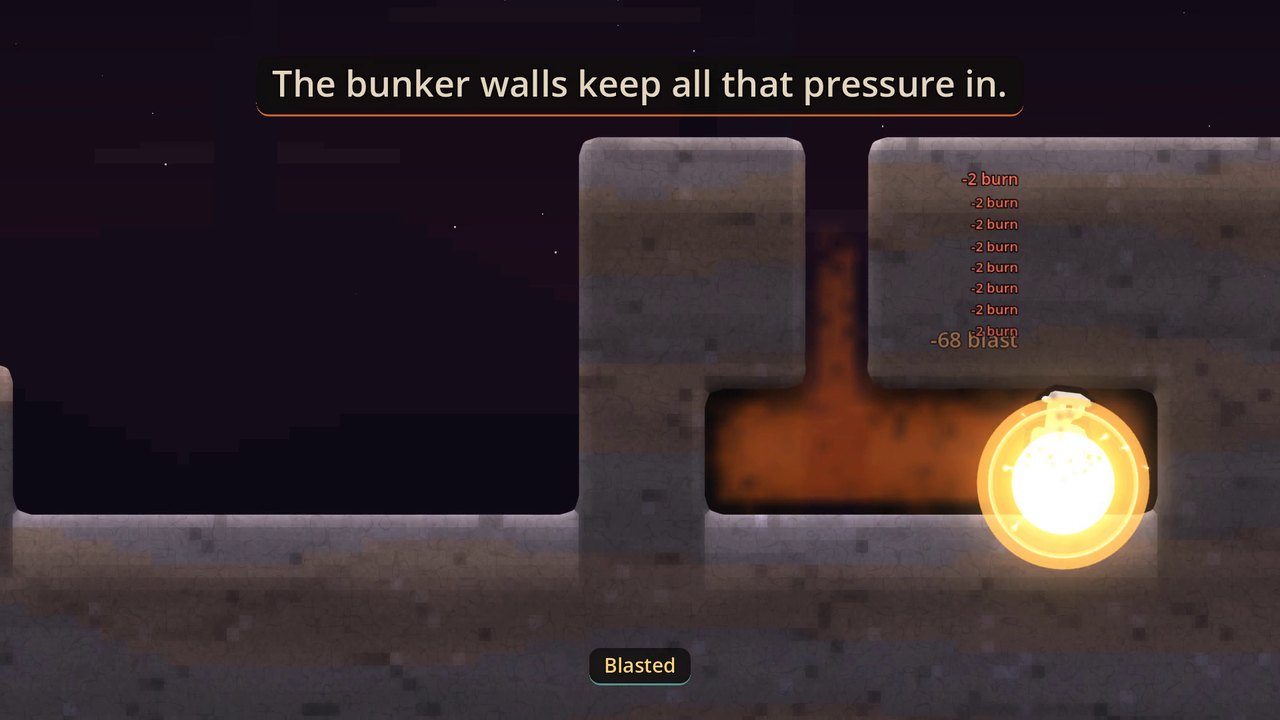
A fuel-air shell going off inside a closed bunker.

The same idea holds for heat and pressure. A fuel-air shell spreads its fuel through the bunker before it ignites, and the walls keep the pressure in. In open air the same shell thins out and does far less.

Units are only hurt by what the world does to them: blast, fire, lava, drowning, being buried, falling rock. That is what makes the terrain a weapon: undermine a ledge, flood a foxhole, burn the brace under a slab.

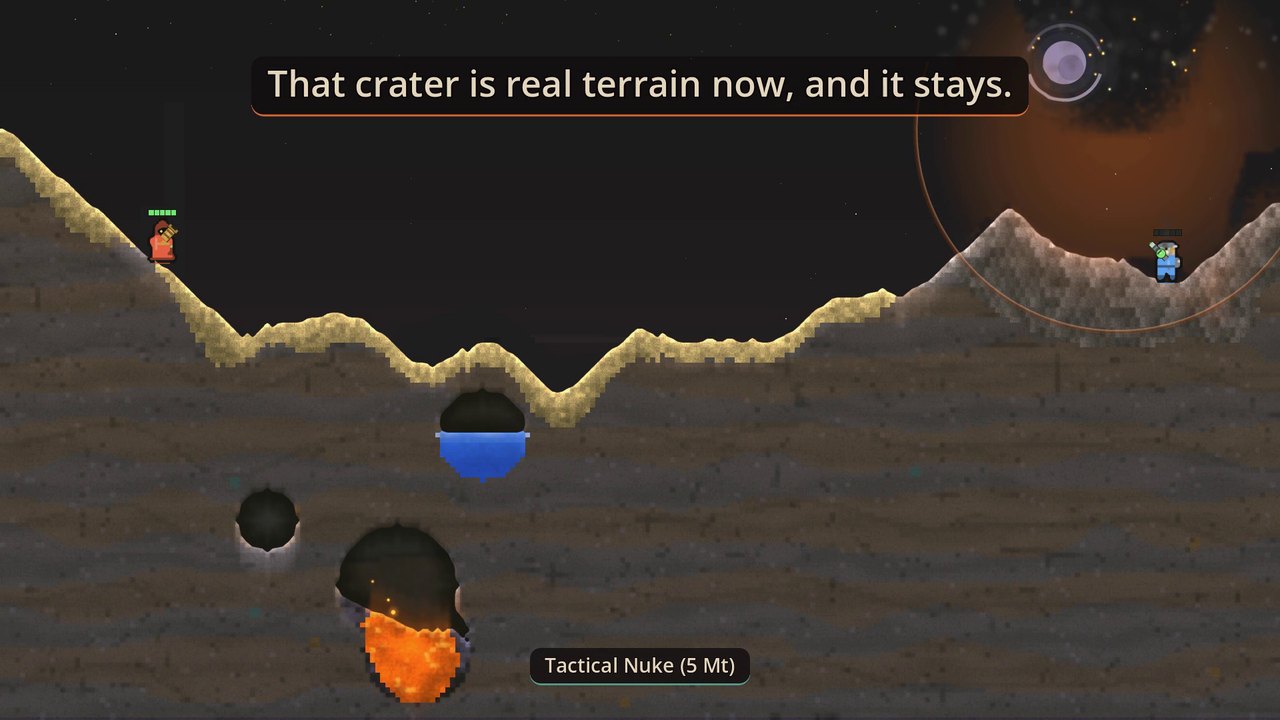
The crater left by the game's largest yield setting.

And at the far end of the scale: five megatons, the game's largest yield setting. The crater stays.